


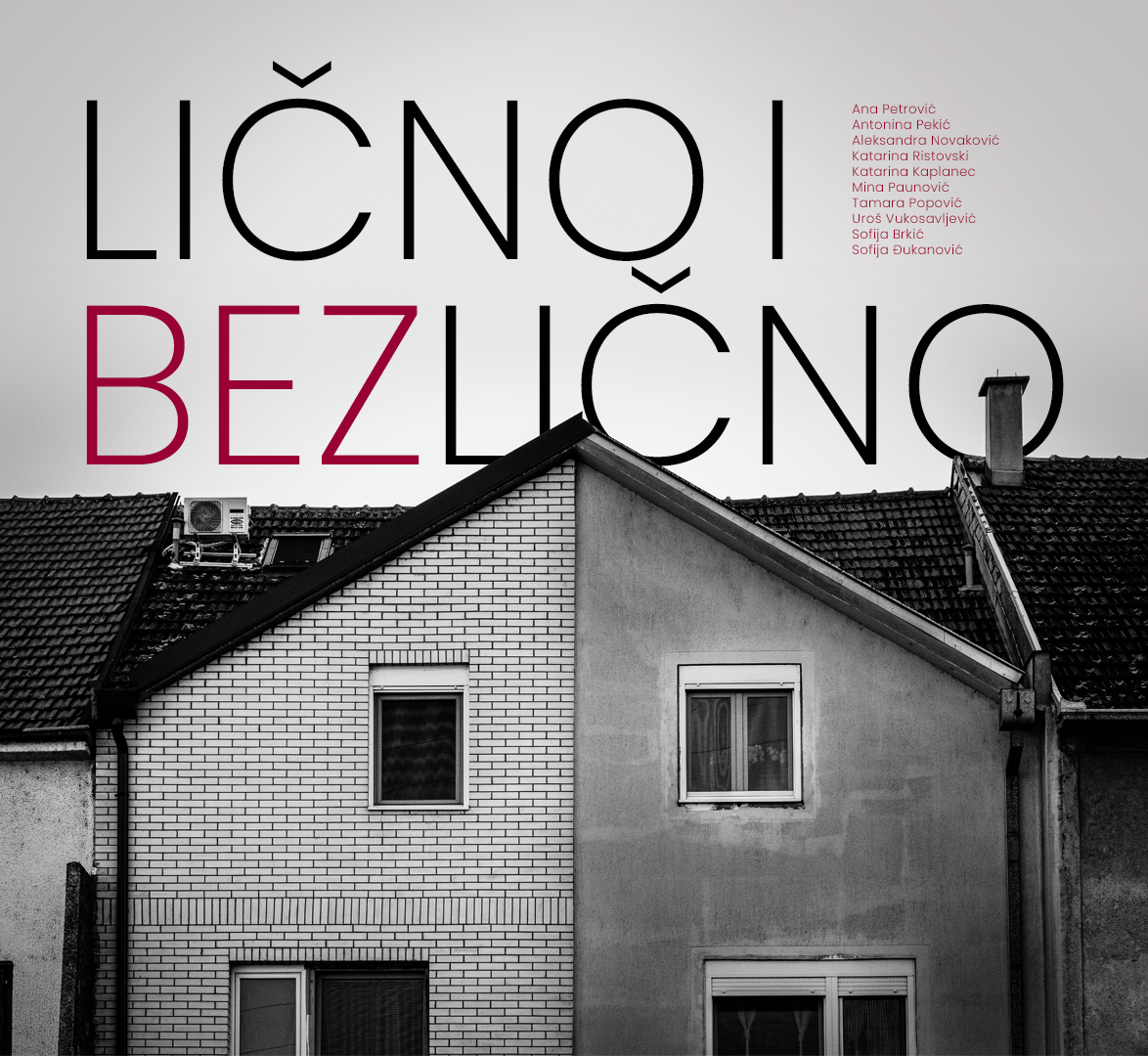
The exhibition presents the works of fourth-year students from the Faculty of Applied Arts in Belgrade, from the Applied Graphics (Photography module) and Design (Textile module) departments. Through series of photographs of urban and rural landscapes and scenes created in the places where the authors live or work, they examine their own relationship to the present and the past, people, and their surroundings. At the same time, they reflect on the long transition period that has transformed everything that once had meaning into something abandoned, neglected, and impersonal.
Photography is personal for the one behind the camera, but also for the one in front of it. It has always been public as well. Photography freezes the past and time, but its meaning is never frozen in time. Each photograph changes with the individuals who observe it, with the passage of time, and with specific circumstances and changes that they bring. The same could be said for a city, nature, a village, a street, or a neighborhood. All of them are public, yet personal spaces. They cannot be viewed solely as spaces or as urban and natural landscapes. They change not only physically but also in meaning, influenced by social, historical, economic, and cultural changes, as well as by the people who live in them and experience them in different ways.
The exhibition features series of photographs by fourth-year students from the Applied Graphics (Photography module) and Design (Textile module) departments. These works were created as part of the Documentary Photography course under the guidance of Professor Aleksandar Kelić, with the cooperation and assistance of documentary photographer and member of the Kamerades photo collective, Marko Risović, and Jelena Matić, collaborator on the Photography module.
Through depictions of urban and rural landscapes, ordinary yet paradoxical scenes, people, and seemingly insignificant signs, the photographers reconsider their relationship to the places where they live, work, or are part of their family history. They also contemplate the passage of time, the connections between the past and the present, the private or personal and the public. Though different, it seems that nearly all the photographs depict what our society stubbornly ignores or has become completely indifferent to. The long transition period, which still shows no end, has transformed places, houses, streets, individuals, and interpersonal relationships—everything that once had meaning and identity—into something abandoned, neglected, and, above all, impersonal.
Jelena Matić