


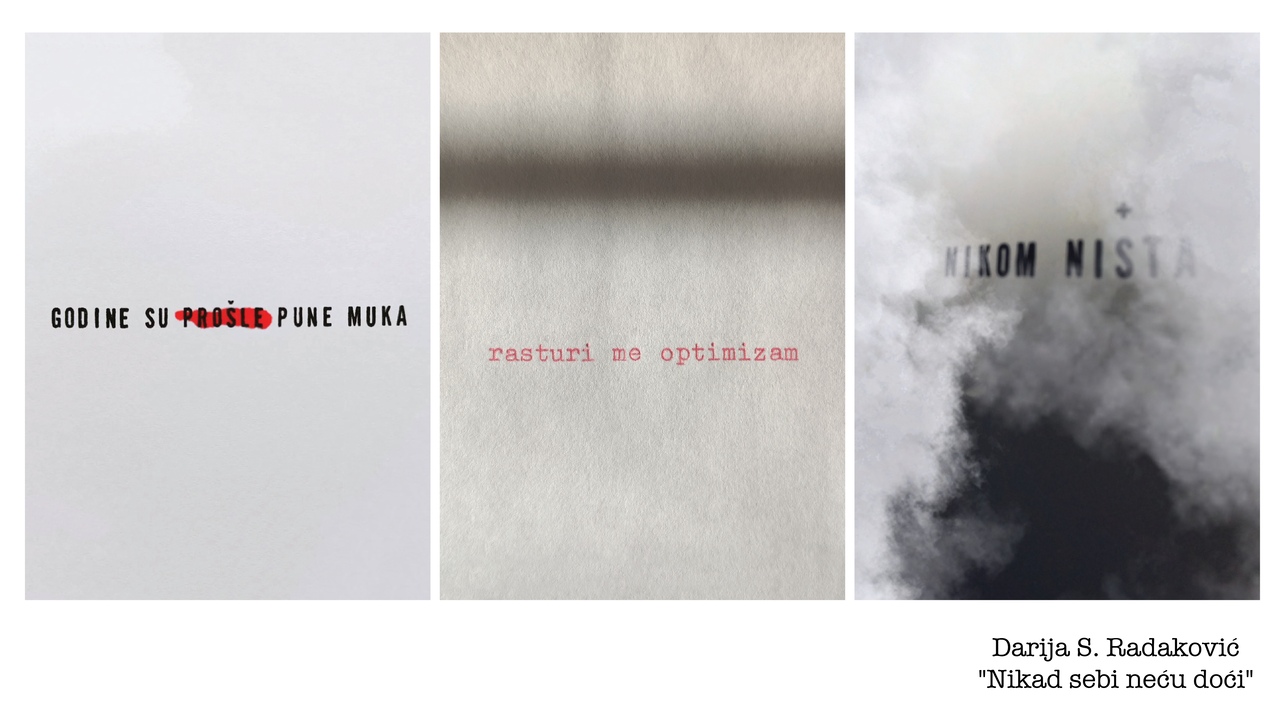
Who is Darija S. Radaković, and does such a person even exist? Is a work of art more important than the person who created it, or perhaps the other way around? Is the point to overcome artistic narcissism or to (over)indulge in it? Ultimately, if we disregard the artist’s own statement, what evidence do we have that the author of a work is indeed the person who claims to be?
According to the artist’s official biography, she was born and raised in Bosnia and Herzegovina and moved to Belgrade amid the bloody war that engulfed the former Yugoslav republic, where she graduated from the Academy of Fine Arts under the mentorship of Dušan Otašević. Today, she divides her time between Canada, where she maintains an address, and Serbia, where she is primarily active as an artist. Through her work, she expresses dissent towards authority, mentality, and a tradition of poor choices, critiquing society by pointing to the consequences of collective misdeeds. She primarily works with text, although other artistic forms are by no means unfamiliar to her. According to the artist, the exhibition “I Will Never Come to My Senses” establishes a field of instability, declaring that security is not an option and that the essence of identity lies in its perpetual transformation.
Her experience of displacement as a refugee in the 1990s, followed by migration in the 2000s, taught her that in life, as in art, there are no permanent, once-and-for-all conquered territories. Darija therefore takes risks, approaching art as a walk along the edge: between the safe unconsciousness of not knowing and the uncertainty of self-examination, between an acquired sense of peace of mind and an awakened awareness of (individual and collective) responsibility. Radaković sees cracks in meaning as a creative manoeuvring space in which to construct her own artistic territory, where the poetic and the ethical merge semantically. Her statements, manifestos, and declarations remind us that art does not have to be beautiful, but it should be responsible. However, the ethical demand placed on art is not the same as the one placed on the artist, who remains deliberately concealed. Through this semantic and identity-based play with the artist’s persona – with their need for self-promotion and inherent artistic narcissism – the focus shifts towards the work itself, whose author may be Darija S. Radaković, but may equally well not be.
This is an art of a post-traumatic and traumatised society, whose material is language, but whose subject reaches much further, delving deeply into the realm of collective memory (and conscious forgetting), where unresolved traumas, through their endless repetition, become sites of identity, while retraumatisation becomes part of the national folklore. Can art offer a way out of this confusion of identity and meaning?
The artist is not a judge, but a witness who does not fall into the trap of confusing guilt with responsibility. While guilt is personal, responsibility is always collective. Darija’s humour is biting and acrid because the subject of these works is, in fact, us, together with the position we have acquired or chosen: that of those who opt for “peace of mind”, “staying out of politics”, “minding our own business”… (un)aware that the skeletons in the closet will not disappear and, even more unsettlingly, that the closet itself may be our own.
Nebojša Milenković
Darija S. Radaković
My artistic practice is rooted in conceptual expression and encompasses performance, ready-made, sculpture, text-based work, assemblage, and installation. With a critical approach to authority, tradition, and the consequences of collective choices, I create works that confront socio-political realities.
Satire often occupies a central place in my work, functioning simultaneously as a critical and therapeutic tool. Having been a refugee in the 1990s and later a migrant, I explore themes of identity, equality, freedom of expression, and the erosion of public dialogue in my practice. I seek to challenge, provoke, and create space for reflection.
Recent exhibitions include Being Political (CZKD, Belgrade, 2025), Matrix-Ost (Museum Kesselhaus Herzberge, Berlin, 2025), Presence / Absence and the Hidden Third (Art Project Space, Athens, 2025), and Human Capital (Contemporary Calgary & Confederation Centre of the Arts, 2024). In 2024, I participated in the 60th Venice Biennale (Croatian Pavilion) as part of Vlatka Horvat’s project By the Means at Hand, curated by Antonia Majača. I was a finalist for the first “Borka Pavićević” Award for my solo exhibition I Like Making You Uncomfortable (2024).
I have participated in artist residencies at CAAF (Canada), AGA LAB (the Netherlands), Konstepidemin (Sweden), NES (Iceland), Institut für Alles Mögliche (Germany), among others.