


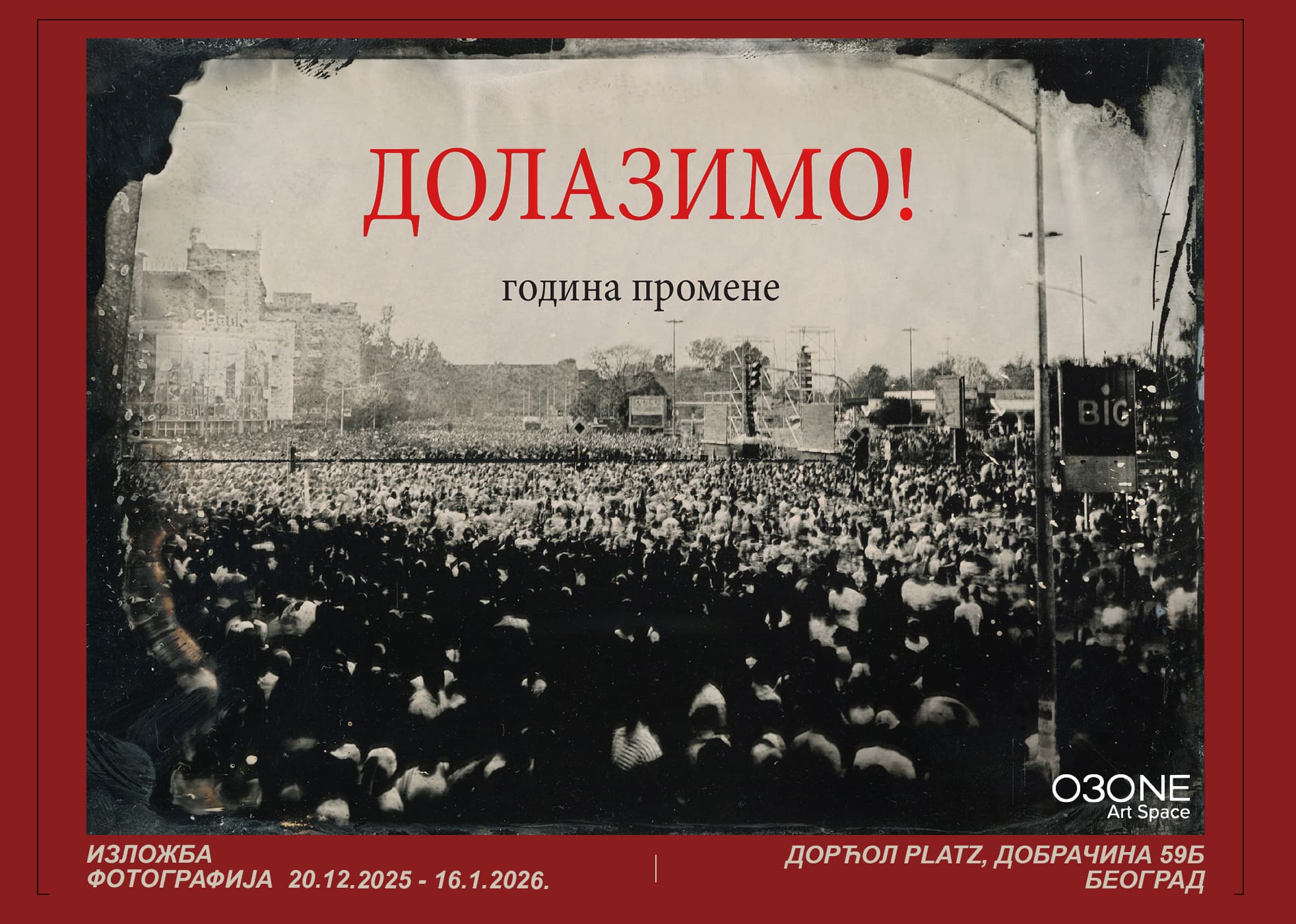
These photographs are a tribute to the courage, unity, and hope embodied by the students and citizens of Serbia in their peaceful protests against systemic corruption. The photographs were created using the wet collodion process, a demanding and delicate 19th-century technique that was once used to document revolutions and wars, making the very content of the photographs a reminder that history is not a distant past, but a cycle that continuously repeats itself and can be changed in the consciousness of a nation only through collective action and unity.
The photographs testify to a time when love and unity began to change the collective consciousness of the people. They were taken during the past year at protests in Belgrade, Novi Sad, Niš, Kragujevac, and Novi Pazar, as well as on the roads across the country.
Milan Vlaški, Predrag Uzelac, and Željko Mandić
Photographers, videographers, enthusiasts of old photographic techniques, professors of photography and related media.
For History and for the Future
Imagine a large wooden camera on an equally large tripod. A large black sheet has been draped over it, and two legs are sticking out from underneath. Then imagine a car with an open trunk, with the same black sheet draped over it, and two legs sticking out from under it. This peculiar sight may not be immediately clear to most people. One thing is certain: underneath both sheets are people, doing something important and interesting. These people are Uza, Mandula, and Mile — three devoted, and you could say eccentric, individuals who decided to immortalize a historical and social moment using a photographic technique from the mid-19th century. The student protests that followed the tragic event and the deaths of sixteen people due to negligence and corruption are slowly but surely changing the people’s awareness of the society in which we live. Changing society itself is a complex and long-term process, requiring both courage and patience.
And that’s exactly what these three needed — an immense amount of courage and patience to embark on such an endeavor, which, from the very concept, seemed like an impossible mission. The wet collodion process experienced a renaissance about ten years ago. It is primarily practiced in studio conditions, because if you are even slightly familiar with this process, you’ll understand why. However, its first application was precisely in the field, as it was a time of discovering the world and documenting key events. Even then, photographers were brave and patient because this process requires plates to be developed immediately after being photographed. And the chemicals are sensitive — they don’t like cold, or heat, or humidity, they need darkness… So, everything is a bit like hunting in the murky, right under that black sheet.
The digital era has brought the possibility to document everything and anything — instantly and with fairly good quality. The road to the audience is lightning fast, visibility is enormous, but the meaning is often minor. Still, the need to say that we were there, and then, is deeply ingrained in modern behavioral codes. It has become the norm for social interaction. Now, imagine Uza, Mandula, and Mile again, but also several hundred, thousands, tens of thousands, even hundreds of thousands of people surrounding them. Some are standing, some are moving — walking, riding bikes, running… Whatever they are doing, they are all gathered with one goal — to say no to the reality that is being served to them, to say no to the values that are imposed upon them, to say no to a system that does not see them, does not hear them, and does not care about them. That moment deserves the biggest camera in the world and the heaviest technique. It deserves that we all make an effort, whether the result will be excellent or not. There are blurry, stained, dark, and overly bright photographs here… far from the perfect precision that modern photography offers. But it is precisely in these “gray spots” that the spirit of resistance emerges, the light and hope that we are the masters of our own lives. If this is a utopian idea, then the idea of waiting on a cold bridge, for a procession of people to pass by with flags, banners, and symbols of free thought, just to take a shot — maybe successful, maybe not — is also utopian. Still, that photograph is here in front of you, along with many others that were created under similar circumstances, chasing or waiting for the right moment — for history and for the future.
Ivana Brezovac
Associate Professor at the Academy of Arts in Novi Sad