


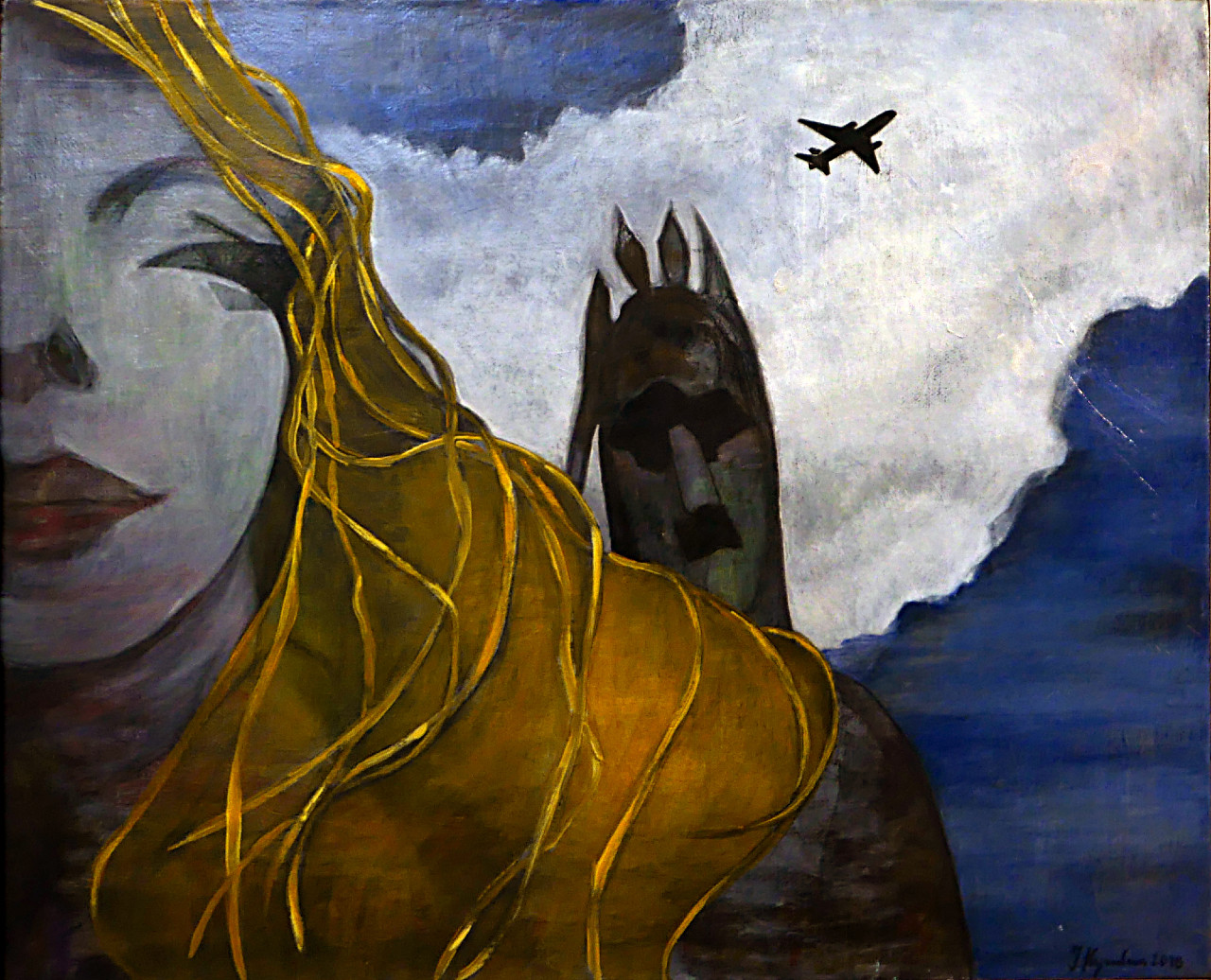
Jana Kunovska presents a series of works that can be conditionally divided into two main thematic groups. The majority of the works are large-format paintings featuring card game motifs. The second group overlaps thematically with the first, consisting of portraits of human figures or cats. Despite this basic division, it is important to highlight that the two groups of works intertwine both thematically and in terms of the technological approach to the creation of the works.
It is difficult to discuss the works without delving into the interpretation of their symbolic repertoire. Most of the works revolve around motifs that clearly reference the card player. The portraits of players, whether in the game or in life, captivate the artist’s attention. In these works, we find faces, figures, eyes, mouths, and signs. The artist captures the cards, emphasizing the states of the participants. The actors are absorbed in their current position, much like individuals in life: importance, determination, uncertainty, expectation. The figures are depicted in portrait situations on large formats, and they are presented in a puzzling manner. The artist creates spaces for them with frequent deviations from expected perspectives. The bold expression of the motifs, almost like a cinematic frame, activates the atmosphere. There is a sense of wonderment about the hidden relationships between individuals and their surroundings, which seems to run through the works. The card players, formed as visual puzzles of signs and symbols, remind us of a time before the advent of computer games, which one can play alone. The card game requires communication between at least two people. As presented, it becomes a visual and technical anachronism.
The second group of works features portrait situations. Here, we find both human faces and portraits of domestic cats. In some works, we may even be unsure whether the artist started from a human or an animal figure. This introduces a sense of uncertainty for the viewer. When painting portrait situations, the artist is well aware of the tradition’s rules. She understands what meanings the painter expects from the portrayal of a figure, and what the observer will interpret. It’s the formal, physiognomic identity of the model, which is reducible to the psychology of character. Here, the social context becomes more interesting. If we analyze the situations, we understand that the actors are immobilized by the predetermined paths laid out for them. Their movements are conditioned by rules, customs, restraint, and other social factors. However, we also notice hidden deviations from the ordinary. We feel the need for resistance to conventions.
The artist respects esotericism. It is legible from the canvas in surreal forms and relationships of sketched, yet not fully drawn, silhouettes of faces, bodies, or signs. The figures play with the viewer’s perception on both the visual and meaningful planes. The surrealist intent to express “the functioning of thoughts” leans on Freudian conclusions about the unconscious. However, Kunovska’s surrealism is not conventional. She does not illustrate the attractive possibilities of imagination or the subconscious. She approaches the artistic theme in a postmodernist manner, where surrealist notes serve the composition based on the experience of the real. Disobedience to the direction and prescribed style is a key characteristic of Jana Kunovska’s oeuvre. Here, realism and surrealist details are experienced only as means of expressing the personal. But not as a fabricated dream, rather as a commentary on the real world around us. Confirmation of this stance is the stylistic indeterminacy and formal inconsistency, allowing these “holograms” to be read on multiple levels.
All of the works offer the recognition of motifs. The communication with the observer happens on two levels: the observer’s perception of an individual work, regardless of its position in the space, and the work as part of the group. The artist is aware that our new, advanced postmodern era leads us into the realm of play and doubt. Every form of visual creation is a form of play, both for the artist and the observer. It is a communication, a flow presented through symbols. This approach points toward the deconstruction of reality. The world is not objectively real. Reality is subjective, determined, and the search for knowledge is inevitably reduced to constant acts of interpretation and reinterpretation. The old concept of the observer must be erased, and in its place, a new one should emerge – the participant. The observer’s experience is a vital fact in describing the system. Thus, the observer is drawn into the project, someone who has experience with the literal meaning of the game. Kunovska offers them an interpretation of the game with very few conventional signs. She forces them to recognize possibilities on their own. Just like in real life, here, within the quiet space of the gallery, the observer must become a participant. Like before a mirror.
Jana Kunovska brings the personal experience of both the observer and the motif at the same time. She ascribes meaning to both roles in the system she presents. Simultaneously, they are both doubt and proof of reality. References to the historical and staged relation between the past and the future yield an interesting result. The exploration, the play, moves in two main directions: the associative direction, compiling fragments of a game that, while real, still belongs to the realm of agreed-upon rules, and the direction of situations concerning personal states in the domain of social relations. At times, calm and at others hallucinatory combinations of faces, shapes, and signs lead the observer into uncertainty regarding perceptual impressions.
The strength of this project lies in its capturing of psychological states. This is emphasized by the choice of models: card players, human figures, cats. The artist only addresses the cards, where the carriers of the action are synonymous with human statuses. Through the portrait of the cat, the artist questions human existence. The voyeuristic approach to the motif adds an intriguing element to the works, as it provokes a type of speculative thinking: who are these figures, and what are they in relation to the artist? Perhaps the closest solution is to say that the artist strongly experienced and compared the game and its figures with real life.
Play and creativity are journeys into the unknown. To reconcile what is learned with one’s own feelings and to react sensitively to the realization is something only the artist can do. Without calculations. While playing. Of course, based on education, experience, and sensitivity. The artist-player is like a traveler who dares to venture into the unknown. The risk of loss is a small stake compared to the satisfaction of the player. Because: the game is only a game when played for the sake of the game. When played for the result, it is no longer a game.
Eugen Borkovsky
The exhibition will be open from 19th April to 2nd May 2022.