



”Only now do we see how little is actually enough for a seemingly functional way of society to reveal its truly inhumane face.”
What drives you?
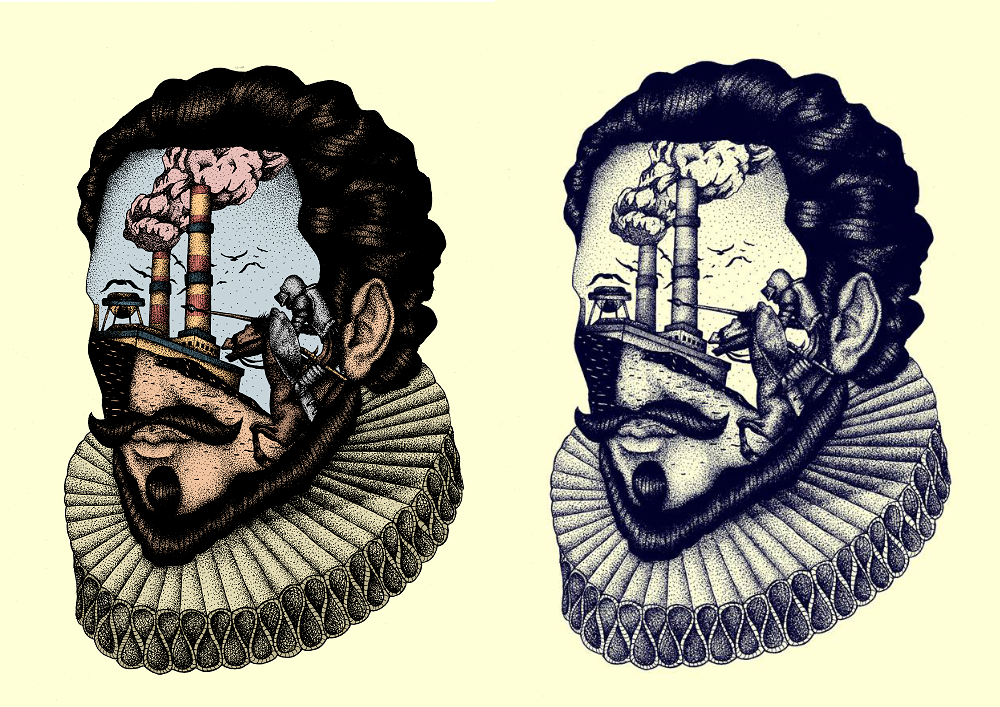
The fuel that drives me in my work and in life, in general, is human imagination. Imagination as a tool for change that can be realized both on a systemic and personal level.
What else do you do?
Besides illustration, I spend most of my time collecting, systematizing, and processing material for my doctoral dissertation. So I’m constantly in motion. Some days I spend reading, some writing, some drawing, some idling, and sometimes I call on my “clones” to give me a hand. Essentially – “there is no rest while renewal is ongoing.”
What should an artist possess, in terms of qualities and skills?
In my humble opinion, an artist should be a person politically engaged in society. I don’t mean political engagement as membership in a political party or singing at campaign events. A human is a social being, shaping the community, and as such, is necessarily a political being (zoon politikon). Through this engagement, an artist points to certain problems in their surroundings through their own unique channel. If art, as a product of the artist, is channeled appropriately, it then has a very subversive character. To paraphrase the famous writer Amiri Baraka, who said that any attempt to separate art from politics is a bourgeois act (allegedly, good art cannot be political). However, since everything in life is political action, even an artist who claims to be apolitical, by making that claim, reveals their political position.


Critique? Who or what can influence your work… its presentation?
Critique is always welcome. I don’t say this just for appearances, I truly mean it. Many critiques have led me to deeper reflection on my work—for example, why male characters often dominate my illustrations. Through this reflection, I expand my understanding of myself and, consequently, of society.
For instance, the critique mentioned above pushed me to explore the multiple layers behind this manifestation: from the dominant patriarchal paradigm, which subconsciously shapes my perception, to the “technical” challenges that, in the early days of my self-taught career as an illustrator, limited my ability to depict female characters—like how to draw hair on a female figure.
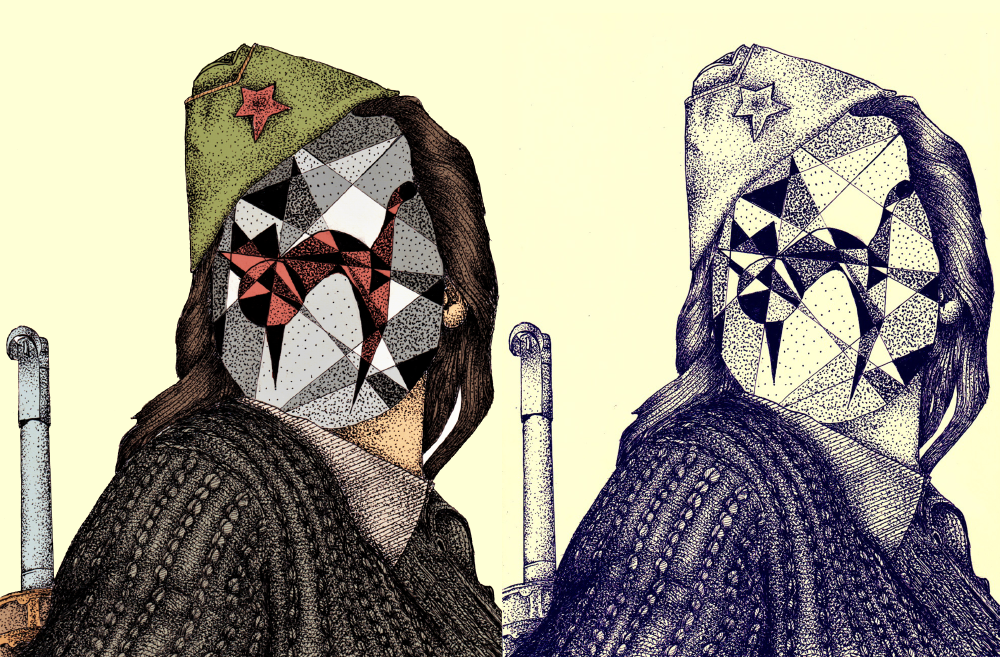
One must not stop at awareness alone; translated into practical action, I have recently chosen to focus more of my work on women who inspire me (a mural dedicated to the revolution in Rojava, a mural supporting the struggle of neighboring communities in Latin America in Buenos Aires, a Vera Obrenović Delibašić mural in Sarajevo delayed by COVID, and new illustrations currently in progress…).
In conclusion, critique changes the artist and helps them “grow.” Of course, a willingness to accept critique does not necessarily mean the artist must conform to the audience’s demands, or more crudely, to the market. Rather, critique should be used as a tool for the constructive development of the artist’s imagination.
Who is your superhero? Who are today’s superheroes?
There is no superhero. There are heroes.
What does isolation mean to you?
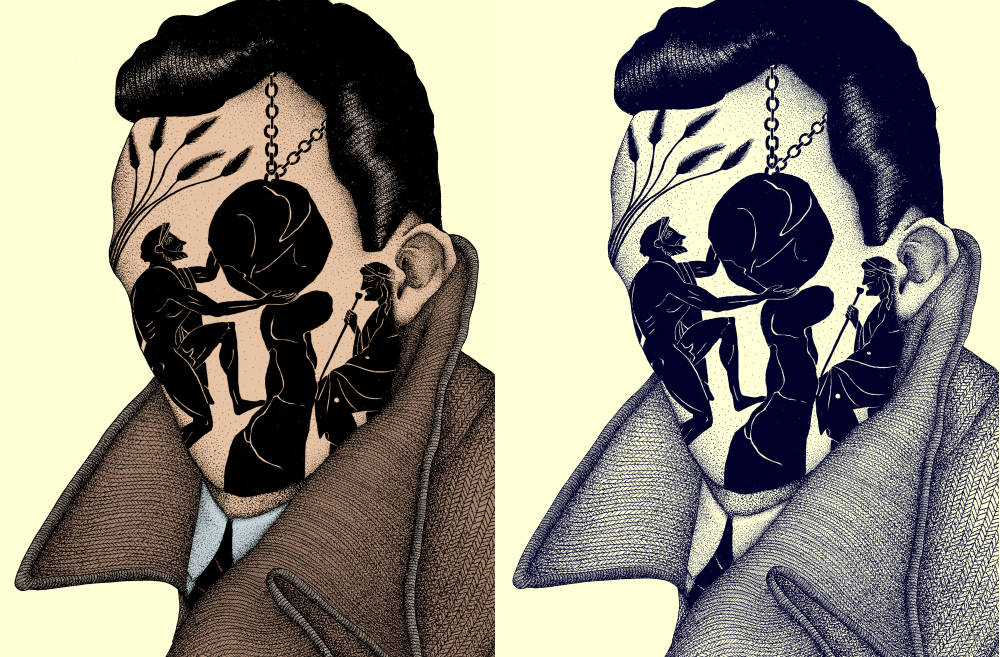
In the context of the COVID-19 pandemic, isolation is a great privilege. In some parts of the world, the very idea of isolation is absurd (India, Pakistan, Bangladesh…). Therefore, it is extremely important to use the time we have in isolation to help those in need and to reflect on and create a more just society. Only now do we see how little it takes for a seemingly functional society to reveal its truly inhumane face.
If we put isolation outside the context of the pandemic, it is something quite different, yet still closely connected to pandemic isolation. But to avoid over-philosophizing, it’s simply refreshing for a person to spend some time alone with themselves. If not physically, then at least “spiritually.”
*Seemingly, because even before the pandemic, the inhumane face was present—it’s just that many people live in their “bubbles” and fail to see all the consequences that capitalism imposes on all inhabitants of Planet Earth, and on the planet itself.

What good can come out of this situation?
Lately, I often think about how all of this will end and what awaits us tomorrow. One thing I am sure of is that I don’t want things to go back to “the way they were,” to “normal.” The system we lived in—which saw no purpose or priority in investing in public health, in infrastructure that would allow every individual a dignified life, or in the possibility of free education—is not a system I want back.
One thing I am certain of is that, during this situation, people have become more aware of the destructive effects of dominant political and economic practices on their lives. What kind of new world could emerge from this situation? I can’t answer that; I simply don’t know. What I do know is that I want a society where there is a dignified life for all, where there are no class divisions, where people care for each other, and where the Earth—the home of all of us—is treated with respect.
“You, Vedran, are dreaming of some utopia!” they all exclaimed at once. On the contrary, fragments of a new society have already been visible in recent weeks. McDonald’s workers in France take over restaurants to distribute meals to those in need, workers in the U.S. strike collectively over inhumane working conditions, young people help the elderly, gangs in Rio de Janeiro declare truces and assist the most vulnerable, we communicate and exchange information more than ever despite quarantine, and factories are being repurposed to produce medical supplies… There are hundreds of practical examples of direct action and responses to the situation.
Tomorrow depends on what we do today (as often repeated in crisis briefings :)), in terms of using this moment to build new productive relations, reflect, critique, practice international solidarity, and resist the system that led us to the consequences of this pandemic.
Do you have a TV at home?
I do, but I rarely watch it. Lately, my routine has become: check the press conference at two, watch the news at night—Croatian, Serbian, Slovenian, Bosnian… Oops, looks like that’s not so rare after all. 🙁
Do you listen to the radio?
Of course, radio as a medium is fantastic. I mostly listen while I work—while drawing. Its unpredictability inspires me the most; you never know what kind of “sonic ammunition” the music editor will supply. On this occasion, I’d also like to greet the team at the local community radio “Radio Rojc,” where I co-host a show called “Isušena Kaljuža” with my colleague Robi. For the curious, this rather unconventional “anti-show” covers topics related to poetry and prose. Translated into our language, with Ravel’s Bolero playing in the background, we spend a few hours farting about the books we’ve read.
Bicycle or sand?
Ah! This is my weak point. The bicycle is a big passion of mine. In the past few years, I’ve had the opportunity to complete routes like Ljubljana-Belgrade, Pula-Dubrovnik, Dubrovnik-Athens… Unfortunately, due to my current time constraints, I haven’t had much time to cycle in the last year. But, as an eternal optimist, I promise myself that once this pandemic situation is over, I will spend more time with my bike.
Beer or wine?
I use the “call the doctor” line. I’m calling on Venedikt Jerofeev, who says:
“Thus – a glass of Zubrovka. Then – at Kulj Cajevska – another glass, but now not Zubrovka, but coriander. A friend of mine once said that coriander has an antihuman effect on a person, meaning it strengthens the limbs and weakens the soul. For some reason, the opposite happened to me; that is, my soul strengthened and my limbs weakened, but I agree that even that is antihuman. Therefore, at Kuljajevska, I also added two mugs of Ziguljevsky beer and a sweet liqueur from the bottle.”
Do you recycle?
In the last six months, I’ve added bins for sorting waste in my household. Since this topic is quite relevant, I’d like to “share a few words” about it. Of course, awareness about the need to protect the environment is a great thing. But it stops being so great when this awareness is reduced to the individual. First, the person who sorts the waste thinks they have done everything in their power to save the planet and has washed away the guilt from their soul. Secondly, the burden of pollution is always carried by the “little person.” “Use biofuels, pay the fee, and we’ll reduce harmful emissions from commercial flights, buy a new Tesla car…” and of course, “that way, we will all help ensure that, together, we can enjoy the blessings of a clean Earth.”
For example, the waste produced in households compared to industrial waste currently plays an unfair game of Earth pollution at a ratio of 10% to 90%. Feel free to ask me for a source 🙂 Conclusion? Definitely start with yourself (that also gives you the legitimacy to criticize), but much more should be aimed at capitalist economic and political practices, which are the driving force behind the situation we are in. “What situation?” you all shout in unison. The situation where global warming threatens us, and this COVID-19 is just a little baby compared to what awaits us in the coming decades (unless a radical shift occurs in current practices).


Book / Film?
I’ve noticed that during the pandemic, it’s become trendy for various artists to recommend books and films, so I’ll take the opportunity to throw out a few of my favorites.
Fiction: Venedikt Jerofeev (mentioned above) – Moscow-Petushki, Sergei Dovlatov – The Suitcase, Danilo Kiš – The Encyclopedia of the Dead, Miroslav Krleža – On the Edge of Reason, Ranko Marinković – Cyclops, Miljenko Jergović – Sarajevo Marlboro, Albert Camus – The Stranger, Vladimir Nabokov – Lolita, Yevgeny Zamyatin – We, George Orwell – Homage to Catalonia, Gabriel Garcia Marquez – Twelve Pilgrims…
Non-fiction / Publicistics: James C. Scott – Seeing Like a State, David Harvey – A Brief History of Neoliberalism, Edward Said – Orientalism, Boaventura de Sousa Santos – Epistemologies of the South, Michael Heinrich – Introduction to Marx’s Critique of Political Economy, John Holloway – Change the World Without Taking Power, Eduardo Galeano – Open Veins of Latin America…
Films? Lately, there’s been a drought when it comes to films—especially those that make you light a cigarette and stare into the distance afterward. Maybe that’s because when you watch them, there’s no one to share your impressions with, so you simply don’t feel like it. Oh yes! The last one I watched was the 1973 remake of Papillon with Steve McQueen and Dustin Hoffman. Not better than the original.
And music…?
Radio + YouTube recommendations that have been the same for years. Haha.
Recommend a website / portal / app…
coronastatistics.com – just kidding… Here are some that are useful for everyone: libgen.is ; sci-hub.tw ; the-piratebay.org 🙂