Continuity of presence

The O3ONE space, at its various locations over the years—this being the seventh—has been primarily recognized as a gallery, but it is certainly much more than that. It is a place where a wide range of divergent initiatives intersect, spanning contemporary visual arts, music, comics, fashion, design, business and marketing, humanitarian work, and alternative education. It serves as a testing ground for continually rethinking exhibition formats and the processes of staging exhibitions and other types of cultural events. Various forms of collaboration and joint projects involving individual artists as well as formal and informal creative groups and teams—including those from the corporate and business sectors—have spontaneously emerged in this environment, transcending conventional boundaries between types of public engagement and the audiences that follow them. In the first three years alone, driven by strong founding enthusiasm, more than two hundred events were realized, sometimes several per day.

The first location of the O3ONE Project was at the former Yugoslav Gallery of Art, at Andrićev Venac 12. After a few years, it moved to Andrićev Venac 10, then to Uzun Mirkova 10—first at street level, then upstairs—later to Koče Popovića 9, then Gavrila Principa 16, and in the last four years it has been located at Dorćol Plac, Dobračina 59. In addition, O3ONE has constantly carried out visual and conceptual experiments on billboards, in collaboration with Alma Quatro, and other projects outside the gallery space, bringing the total number of realized events to two and a half thousand to date. These were largely not ephemeral events or incidental exhibitions meant to impress merely by quantity or variety; rather, they were often installations and processes pivotal to the careers of the artists who conceived and executed them. Evidence of this includes two “Vladislav Ribnikar” awards for visual arts, given by the newspaper Politika, for exhibitions produced at O3ONE: Predrag Nešković’s NEW DANDY in 2007 and Raša Todosijević’s Mali dnevnik III in 2009.

The first event within the O3ONE program, in September 2004, was a live musical performance featuring Zbigniew Karkowski, an experimental musician and composer of acoustic and electroacoustic music, and Helmut Schäfer, an artist from the demo music scene. It was realized in collaboration with the Činč initiative, the project Composer in the First Person, and the Multimedia Institute (MAMA) in Zagreb. This launched one of O3ONE’s program lines, focused on experimental music. Parallel to this was a program line dealing with the visual aspects of the image and identity of alternative music performers, initiated by Vuk Vidor with his ambient installation EKV Rewind. That first year, Mihael Milunović, with the exhibition Pod Če, which explored “the connection between guerrilla warfare principles and information networks, new social logic, and philosophy of resistance,” demonstrated how an iconic figure like Ernesto Che Guevara could be reimagined through artistic investigation and experimental installations to reclaim a potential for rebellion and resistance. Each new artist subsequently brought additional dimensions to O3ONE’s programming, often beyond the boundaries of their previous standard artistic practice, approaching exhibiting at O3ONE as a challenge to present something unusual and unexpected.

The continuity of the O3ONE Project is demonstrated by the fact that the aforementioned Peđa Nešković and Raša Todosijević, as well as Vuk Vidor and Mihael Milunović, are present with their works even in this ad hoc exhibition, a brief reminder that two full decades have passed since O3ONE was launched. Among other participants, many of whom have previously realized installations or individual works within the O3ONE Project multiple times, are other doyens of the visual arts, as well as the fashion, design, comic, and animation scenes, recognized by critics and the public for their distinctive styles, while also producing works appropriate for this specific space and context. Were we not so accustomed to their frequent exhibition presence, any exhibition including works by, for example, Uroš Ðurić, Aleksandar Zograf, and Slavimir Stojanović would in itself be considered a significant cultural event. However, in the O3ONE space, their works as part of an exhibition are entirely expected, as is their personal presence, whether as authors, guests, or participants in someone else’s artistic or humanitarian project. As long as such caliber of artists responds to O3ONE’s invitations—alongside numerous emerging artists who also find a place in O3ONE’s programming, as well as artists crossing from one cultural field to another—O3ONE’s position on the local, regional, and international scene will be secured.

Stevan Vuković

Aleksandar Gajić

He was born in Belgrade in 1974. He is a Serbian comic book author, illustrator, director, and animator. He is best known for his graphic novel Tehnotajz (Technotise), created with writer Darko Grkinić, which later inspired the animated film Technotise: Edit & I. He is also an illustrator for the magazine Politikin Zabavnik. His six-part comic series Le Fléau des Dieux (published in Serbian as Bič Božji), created with French writer Valérie Mangin, has been reprinted multiple times in France and translated in the USA, Serbia, and six other countries.

Aleksandar Gligorijević

He was born in Belgrade in 1962. He graduated in sculpture from Santa Monica University in California in 1991. He works with the form of materials through the reuse of industrial products, using parts of airplanes to negate their original purpose and recognizability, and then translates them into the language of visual art.

Aleksandar Zograf

Aleksandar Rakezić, born in 1963 in Pančevo and better known by his pseudonym Aleksandar Zograf, is a Serbian and former Yugoslav comic book author. He began publishing his first comics in 1986 in the former SFRY, appearing in magazines such as NON, Ritam, Rock, and Mladost. In the early 1990s, he started publishing internationally, primarily in the United States, in magazines including The Comics Journal, Zero Zero, Weirdo, Rare Bit Fiends, Buzzard, Cow, and Tantalizing Stories.

Anđela Grabež

She was born in 1982 in Banja Luka. She earned her degree in sculpture under Professor Mrđan Bajić at the Faculty of Fine Arts in Belgrade, and later completed a master’s in marketing communications at the Faculty of Dramatic Arts in Belgrade. Anđela is a sculptor and passionate film enthusiast, and is also active as a set designer, art director, creative professional in marketing campaigns, and creator of documentary films and artistic video works.

Biljana Cincarević

Biljana Cincarević was born in 1975 in Belgrade. From the beginning of her career, she has focused on depicting the female body, which has always been her source of inspiration. After graduating from the Academy of Applied Arts, Biljana devoted herself to participating in numerous group and solo exhibitions in Serbia and abroad.

Branko Lukić

Branko Lukić (born 1970) is an industrial designer who has redefined the approach to design. Working at leading global design companies, he realized it was time to redesign the way we shape our reality. He understood that the modern consumer cares about much more than just a product’s function and features. He is the founder of the NONOBJECT project and, in his career, served as a lead industrial designer at two of the world’s largest design studios, FROGDESIGN and IDEO, where he led projects for clients such as Nike, Adidas, Samsung, Motorola, SAP, Pepsi, Starbucks, Ford, Nestlé, and many other international companies.

Dragan Rajšić

Born in 1967 in Pula, Dragan Rajšić graduated in sculpture from the Faculty of Fine Arts in Belgrade, where he also earned his doctorate in 2016 and currently teaches in the Sculpture Department as an associate professor. His works are included in numerous museum, private, and public collections.

Džoni Racković

Nenad Racković, a multimedia artist, writer, and performer, was born in Belgrade in 1967. He studied acting at the Faculty of Dramatic Arts. His first poem was published in Književna reč in 1984, and his first exhibition took place at SKC in 1985. He edited and hosted the cult radio show Ritam srca on Radio B92 and was a regular contributor to Beorama. He has organized 18 solo and 19 group exhibitions, and directed three films: Kako je propao rokenrol (How Rock ‘n’ Roll Failed), Crni bombarder (Black Bomber), and Marble Ass, as well as the television film Poslednja dadaistička predstava (The Last Dadaist Performance).

Igor Mandić

Born in 1973 in Sarajevo, he has lived and worked in Belgrade since 1989. An independent visual artist specializing in photography, he has held 8 solo exhibitions and participated in numerous group shows. Until 2002, he worked as a photojournalist for newspapers and magazines, after which he opened his own studio. His photographs have been published in a wide range of domestic and international magazines and newspapers (Status, Elle Croatia, Mark Magazine – Netherlands, Toyota British Magazine, Daily Telegraph, Sunday Telegraph, etc.), as well as in brochures, posters, books, billboards, advertisements, fashion agencies, and on numerous websites.

Jelena Blečić

She was born in Belgrade in 1974. She earned her degree in painting and completed a master’s in the same field at the Faculty of Scenic and Applied Arts, Academy of Fine Arts, Union University in Belgrade, under Professor Gordan Nikolić. She works in painting, original design, the theory of creative identity, and applied psychology. She is the founder and artistic director of the design project Fun Fan. As a visual artist, she has been actively creating for over two decades, with more than 20 solo exhibitions and numerous campaigns and projects realized in Serbia and abroad.

Lana Vasiljević

Lana Vasiljević (born 1973) earned her bachelor’s and master’s degrees at the Faculty of Fine Arts in Belgrade (Sculpture Department). She has been exhibiting sculptures and objects since 1997 and has been actively engaged in graphic design since 2002. She was a recipient of the KulturKontakt program scholarship in Vienna and the ArtsLink Residency at ISCP in New York. She has participated in numerous solo and group exhibitions. Lana has worked as an art director in various marketing and design agencies and has taught modeling/sculpture at the School of Design in Belgrade. Her works are included in the collections of the Museum of Contemporary Art in Belgrade, the Museum of the City of Belgrade, the Nadažda Petrović Art Gallery, as well as other public and private collections.

Magični Čiča

Dragan Radović, born in 1955, studied anthropology in Belgrade. He developed a love for drawing as a child, but has been professionally engaged in painting since 1976. Entirely self-taught, Dragan exhibits most of his works in Belgrade and Paris. His art is closely related to the Belgrade School of Fantasy, Urban Cyber Naïve, and the associative symbolism of Art Brut and Marginal Art.

Mihael Milunović

He was born in 1967 in Belgrade. He earned his master’s degree at the Faculty of Fine Arts in Belgrade in 1995 and completed specialized studies at the École Nationale Supérieure des Beaux-Arts in Paris. He is the founder of the NGO Pro Art ORG in Belgrade and has taught at art academies in Paris, Saint-Étienne, and Cetinje. His works—including paintings, sculptures, photographs, installations, and video art—are included in numerous international collections, notably: Museum Ludwig, Vienna; SOLO Collection, Madrid; SIEMENS Collection, Vienna; Esterházy Collection, Eisenstadt; AZRAK Collection, Marrakech; and the Museum of Industry and Fine Arts, Saint-Étienne.

Monika Lang

She was born in 1978 in Sombor and graduated from the Faculty of Applied Arts in Belgrade. As a freelance illustrator and graphic designer, she primarily participates in projects related to culture and publishing. She is a co-founder and member of the design group Turbosutra, with which she has been continuously engaged in creative and exhibition work since 2006; their most well-known project is Laserski samit jeftine grafike (Laser Summit of Cheap Graphics). She has taught in the Graphic Design Department at the Faculty of Arts and Design. Book cover design is one of her favorite forms of expression, as it combines her two passions: reading and drawing.

Nataša Šarić

She is an independent fashion designer from Serbia who began her career in 1991. She has worked as a designer for ready-to-wear collections for various fashion companies while simultaneously creating her own signature collections. Combining visual art and fashion, Nataša collaborates with a wide range of artists, including popular music bands, theater groups, comic artists, sculptors, and photographers from around the world.

Nikola Krivokapić

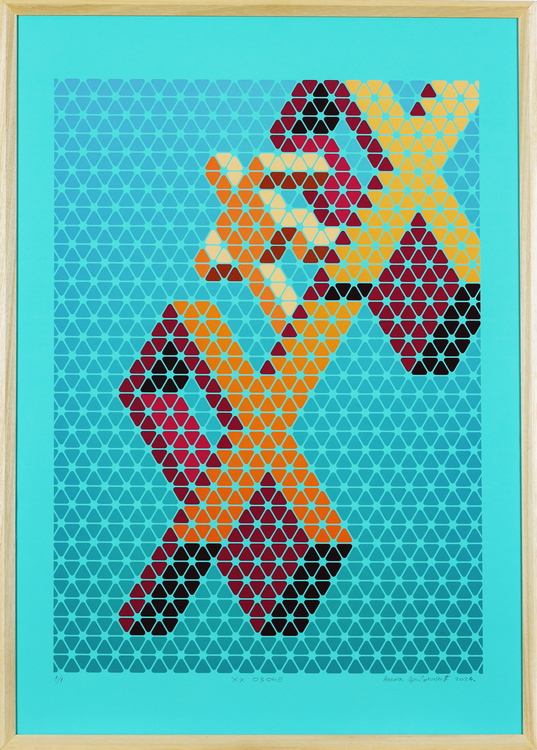
He was born in 1981 in Kraljevo and completed his undergraduate studies in industrial design at the Faculty of Fine Arts in Belgrade. Nikola is a designer and artist who lives and works in Belgrade. He has been active in the marketing world for the past 20 years, realizing campaigns and projects for numerous companies both domestically and internationally. Throughout his career, he has achieved notable results in industrial and conceptual design, as well as in visual arts. He has participated in multiple group exhibitions and art and design festivals in Serbia and abroad. He is also the author of the project Segmenti, which he has been developing for the past six years. Nikola continually strives for multidisciplinary practice, placing design in the context of art and vice versa.

Nikola Velicki

He was born in 1983 in Niš and graduated from the Faculty of Fine Arts in Belgrade in 2008, under Professor Miodrag Mlađović. He earned his doctorate at the same faculty, under the mentorship of Professor Vladimir Veljašević. Since 2019, he has been teaching in the Graphic Arts Department at the Faculty of Fine Arts in Belgrade. He has held 16 solo exhibitions and participated in more than 50 group exhibitions.

Peđa Nešković

Predrag “Peđa” Nešković was born in 1938 and graduated from the Academy of Applied Arts in Belgrade in the class of Professor Mihailo S. Petrov. Since 1958, he has participated in numerous group exhibitions in Serbia, former Yugoslavia, and abroad. Peđa Nešković emerged on the art scene in the early 1960s, during the dominance of Informel and abstraction, with works closely aligned with the Belgrade New Figuration of that period, incorporating elements of pop art and poetic fantasy. In the 1970s, Nešković’s style evolved toward lyricism, irony, and narrative anecdotes.

Raša Todosijević

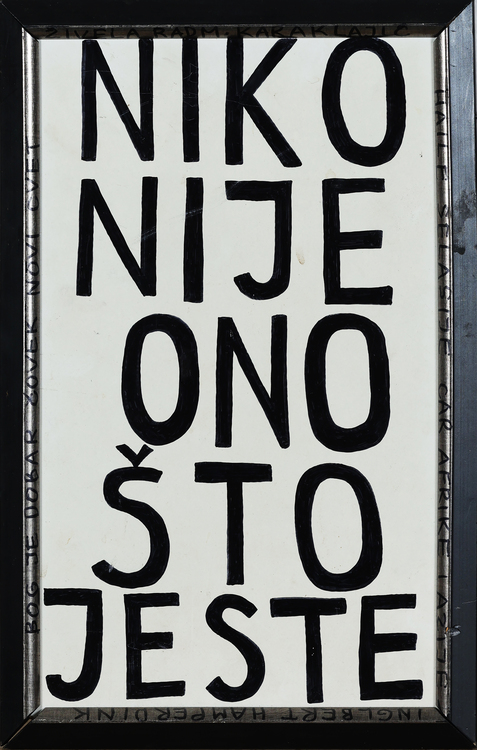
Dragoljub “Raša” Todosijević was born in Belgrade in 1945 and graduated from the Academy of Fine Arts in Belgrade in 1969. He was one of the first artists to introduce conceptual art—new artistic practices and media—to the Yugoslav art scene in the 1970s. His most famous works, including Šta je umetnost? (Was ist Kunst?) and Bog voli Srbe (Gott liebt die Serben), among many others, have earned him an international reputation. He has been exhibiting solo since 1969 and has participated in numerous group exhibitions in Serbia and abroad since 1970. His works are included in the permanent collections of many major museums worldwide.

Saša Pančić

He was born in Mostar in 1965. He graduated in 1989 from the Faculty of Fine Arts at the University of Arts in Belgrade, in the Painting Department. He earned his master’s degree in 1992 at the same faculty, in the Drawing Department, under Professor Dragan Lubarda. He gained the status of independent artist in 1988. In addition to numerous solo and group exhibitions, Saša Pančić has participated in many festivals. Today, his works are featured in the collections of numerous museums and public spaces, and are also part of various public collections.

Slavimir Stojanović Futro

Slavimir Stojanović, born in 1969, is a Belgrade-based graphic designer, creative director, illustrator, and visual artist. He studied at the Academy of Applied Arts in Belgrade, the HDK – School of Design and Applied Arts at the University of Gothenburg (Sweden) under Professor H.K. Eriksson, and the Academy of Fine Arts in Ljubljana, Slovenia. He has received over 300 international awards and recognitions in the field of design. He is the owner of the distinctive brand Futro, dedicated to celebrating the eternal joy of life through a healthy dose of humor.

Slobodan Jovanović Coba

He is the founder and creative director of the branding agency After Studio, formerly known as Coba & Associates. He has been working in design since 1985 and, over the years, has gained experience in numerous agencies, working for some of the largest regional and multinational brands. He is also the founder of the portal Designed.rs and the project Packtivity. He has taught the Graphic Design course at the SAE Institute in Belgrade, participated in numerous panels, and lectured at professional conferences and festivals.

Tadija Janičić

He was born in 1980 in Nikšić and graduated from the Academy of Arts in Novi Sad in 2004, in the class of Professor Milan Blanuša. Since 2003, he has been exhibiting both solo and in group shows, in Serbia and abroad. Although primarily a painter, Tadija expresses himself equally authentically as a sculptor. His works depict everyday life in a humorous, sometimes even sarcastic, manner.

TKV

TKV (The Kraljica Vila) was born in 1988 in Belgrade. After attending the Graphic School, Photography Department, she continued her formal education in media theory at the Faculty of Media and Communications, majoring in Communication Studies. She has been engaged in street art since 2004. Her artistic career began at the age of 16 with a stencil of Amélie Poulain. She has exhibited at the French Cultural Center in Belgrade and presented her work in Paris at the Cultural Center of Serbia in the exhibition Face au Mur (Face the Wall).

Uroš Đurić

He was born in Belgrade in 1964. He studied art history at the Faculty of Philosophy in Belgrade, as well as painting at the Faculty of Fine Arts, where he earned his master’s degree in painting in 1998. In the early 1980s, he was one of the protagonists of the Belgrade punk scene, joining the band Urbana Gerila as a drummer. He has been active in the visual arts scene since 1989, co-founding the Autonomist Movement with Stevan Markuš, with whom he co-authored the Manifesto of Autonomism. He has participated in numerous art actions, workshops, and comic publishing projects, and works in graphic design. He is also one of the founders of the artistic association Remont, through which he established the Remont Gallery and the eponymous art magazine.

Vesna Orović

In moving through artistic, urban, and geographic spaces, and drawing from all these impressions and conversations, Vesna devises a new style and personal creative response—a response in color—to Belgrade’s demagnetized everyday life. In this process, she currently finds her sense of freedom.

Vladimir Perić Talent

Born in 1962, he is a Serbian multimedia artist who has been active on the contemporary visual arts scene in Serbia and abroad for almost three decades. He studied graphics and photography at the Faculty of Applied Arts and Design in Belgrade. His artistic work spans over three decades and can be divided into three periods: exhibiting under the pseudonym Talent, then as founder and member of the art group Talent Factory, and finally exhibiting under his own name within the framework of his new ten-year project, Museum of Childhood.

Vuk Vidor

Vuk Vidor, born Veličković in 1965, is the son of painter, illustrator, and engraver Vladimir Veličković. He studied architecture at the École Nationale des Beaux-Arts de Paris-Tolbiac and graduated in 1990. In 1992, Vuk Vidor decided to devote himself to painting. The series of drawings he began in 1989, titled Kralj Mastilo (King Ink), often serves as the foundation for his works.

Zoran Naskovski

Born in 1960, Naskovski is one of the most significant representatives of the independent art scene of the 1990s and has been continuously active in the field of contemporary art for over three decades. He earned his master’s degree at the Faculty of Fine Arts, University of Arts in Belgrade, in 1999. He works across a wide range of media, including painting, video, film, installation, performance, photography, and internet projects. His works have been exhibited both in the Serbian art scene and at major exhibitions and art events abroad.

Zoran Velimanović

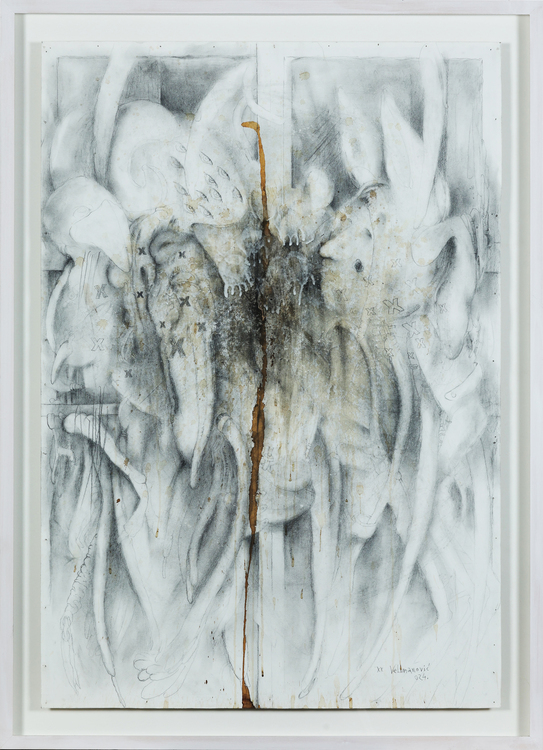
Zoran Velimanović was born in 1964 in Belgrade. He specialized in oil painting and sculpture across various media, including metal, bone, wood, leather, hair, resin, and even living organisms. His three-dimensional works are part of what is today described as New Sculpture, and are strongly influenced by Arte Povera and Altermoderne. Since the late 1990s, many of his major works have incorporated structures using bones, reflecting the artist’s fascination with archaeology and organic remains. Velimanović’s personal artistic practice has earned him a reputation for grotesque critique of contemporary globalized society and the art scene. His works have been exhibited in numerous cities across Europe.

The Good Spirit of Belgrade Among Us

The Belgrade art scene came alive on October 11, 2024, when O3ONE Art Space celebrated its 20th anniversary in an extraordinary way. As part of the exhibition O3ONE XX: Just Cultural, 30 works by renowned artists were presented. The event attracted over 1,000 visitors, highlighting the significance of this cultural project for the city.

The atmosphere was further energized by a performance from DJ Marko Nastić, one of the leading DJs, whose three-decade-long talent and unique style thrilled the audience. The visual experience was enhanced by VJ Milan Ličina, while video art from the Reflektor Theatre’s Manifest 2.0 added another dimension to this multimedia spectacle.

This anniversary was not just a celebration of two decades of O3ONE Art Space, but also a revival of Belgrade’s spirit through the fusion of visual art, music, and technology. The event demonstrated that Belgrade’s cultural scene remains vibrant and innovative, continuing the tradition of creative resistance and the celebration of life through art.